
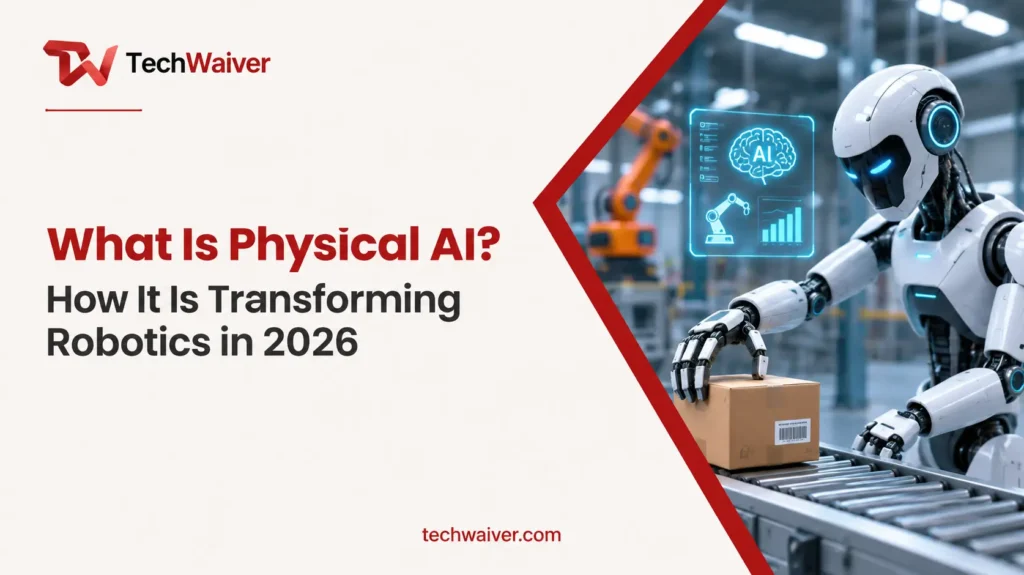
Artificial intelligence has transformed the way humans work, communicate and engage with technology. A lot of these developments, such as image generators and AI-powered chatbots, have been centred on the digital realm. But 2026 is the year AI moves out of computer screens and into the physical world.
This is Physical A.I. .
Traditional artificial intelligence systems only collect information and provide digital outputs . Physical AI , however , allows machines to understand their surroundings , make judgements , and take action in real-world situations . It uses artificial intelligence and robotics to give machines the ability to interact with objects, move around environments and respond to changes in conditions.
This is making robots more adaptive, clever and useful in industry. Physical AI in robotics is unlocking new opportunities for automation and human-machine collaboration in manufacturing facilities and warehouses, healthcare environments and autonomous cars.
But what is Physical AI, how does it operate, and why is it becoming such an important technology in 2026? Let’s have a look.
What Is Physical AI?
Physical AI is artificial intelligence that can sense, understand and act on the physical world through machines like robots, autonomous vehicles and other smart gadgets.
Simply said, it offers AI a physical body to do things with, rather than just generating information.
For example, a classic AI assistant can tell you how to pick up a glass. A physical AI-driven robot can see the glass, figure out how to go to it, adjust its grasp and pick it up physically.
Physical AI is different from traditional artificial intelligence in its capacity to link intelligence with physical actions.
At its heart, Physical AI is a blend of numerous technologies including:
- Machine Learning: Helps robots learn from data and improve their performance over time.
- Computer Vision: Allows machines to recognize objects, people, and their surroundings.
- Natural Language Processing: Enables robots to understand human instructions.
- Sensors and Actuators: Help robots collect environmental information and perform physical movements.
- Robotics and Motion Planning: Allow machines to navigate spaces and complete physical tasks.
- Reinforcement Learning: Helps robots improve their actions through feedback and experience.
Together, these technologies create intelligent machines capable of making decisions and taking action in real-world environments.
What Is Embodied Intelligence in Robotics?
Embodied intelligence is the notion that intelligence arises via interaction with the world around us. So an intelligent system learns by perceiving, moving, experimenting and responding to real world conditions rather than simply relying on stored information.
In robotics, this means a machine uses its physical body to learn how the environment operates.
Think of a robot that is learning to unlock a door. It has to know what the handle is, how the door opens, how to orient its arm, how much force to use, and how to correct its course when something goes wrong.
It asks for more than just recognising visually The robot must link perception, logic, motion and feedback.
This is done using embodied intelligence, which pairs an AI model to a physical system that can operate on its environment.
It also makes robots more flexible. They can react to unforeseen changes and adjust their behaviour, rather than always obeying the same programd instructions.
How Does Physical AI Work?
Physical AI operates through a continuous loop of perception, reasoning, action, and learning.
Traditional software is mostly about digital information, whereas physical artificial intelligence systems have to be continually responsive to the environment.
This is how the procedure works.
1. Perception: Understanding the Environment
The first step is collecting information about the physical environment.
Robots use cameras, depth sensors, microphones, LiDAR, and tactile sensors to identify objects, recognize obstacles, measure distances, and understand their surroundings.
For example, a warehouse robot can use cameras and sensors to identify packages, locate shelves, and detect people moving nearby.
2. Reasoning: Making Intelligent Decisions
The initial stage is to collect information about the physical surroundings.
Robots are equipped with cameras, depth sensors, microphones, LiDAR and touch sensors to recognise things, detect obstacles, gauge distances and sense their environment.
For instance, a warehouse robot can utilise cameras and sensors to see packages, find shelves, and sense people moving around.
3. Action: Performing Physical Tasks
The AI system takes the information it has gathered, processes it, and decides what to do next.
But advanced AI models can read instructions, recognise diverse scenarios, and create plans to get things done.
For example, if a robot encounters an unforeseen impediment in its path, it can assess the situation and take an alternate route.
4. Learning: Improving Through Feedback
Physical AI continues to work after it has finished its action.
The system can learn from the feedback of the sensors and previous experience and do better next time .
This knowledge can be used to alter the robot’s approach in the future if it makes a mistake when grasping an object.
This feedback loop makes robots more adaptive and trustworthy.
Key Technologies Powering Physical AI in 2026
There are some technology advances that are driving Physical AI progress. The most crucial is cooperation to make intelligent robots more capable of operating in difficult contexts
Vision-Language-Action (VLA) Models
Vision-Language-Action (VLA) models aim to jointly grasp vision, language and execute physical action.
They help robots to understand human directions, recognise objects and convert instructions into movement.
For example, a person may direct a robot to pick up a certain product and put it on a nearby table. The system understands the request, recognises the object and determines the movements needed.
AI Foundation Models
Foundation models give robots more general purpose intelligence.
Instead of training a new AI model for each task, developers may employ models learned on huge, diverse datasets to accomplish several tasks.
This enables robots to transfer learnt skills across activities and situations.
Digital Twins and Simulation
Training robots directly in the real world can be expensive, slow and sometimes dangerous.
This is when simulation technology is coming in – it creates virtual settings where robots may rehearse a task before doing it in the real world.
Digital twins can also reproduce real-world machines, equipment and working conditions.
Developers are able to test movements, diagnose issues and enhance robot performance without having to use the physical hardware over and over again.
Edge AI and Real-Time Computing
Robots have to make decisions in milliseconds sometimes especially when navigating around people or manipulating sensitive objects.
Edge AI means machines process information closer to the hardware, rather than relying on remote cloud servers.
It lowers communication delay and enables quicker reactions in real-world conditions.
Real-World Applications of Physical AI in Robotics
Physical AI is no longer just a research lab curiosity, but is becoming increasingly significant across a range of businesses.
Some of its most promising applications in 2026.
1. Manufacturing and Industrial Automation
Manufacturing is one of the key areas for adoption of Physical AI.
Industrial robots have typically been used in highly regulated conditions and repetitive duties. Physical artificial intelligence can help these systems adjust to shifting manufacturing needs.
Smart robots can help with:
- Product assembly, handling of components.
- Quality assurance and fault detection.
- Transport of materials.
- Surveillance and maintenance of machines .
- Handling of diverse objects in production lines.
This can increase operational efficiency and reduce the need for humans to conduct repetitive or risky jobs.
2. Warehouse and Logistics Operations
Warehouses are all about inventory management, packing, shipping, and constant mobility.
Physical AI-powered robots can move about storage facilities, locate parcels, deliver goods and aid workers with order fulfillment.
More advanced robots, unlike the traditional automated systems, can adapt to unanticipated obstacles and changing layouts.
This improves the reactivity and flexibility of logistic activities.
3. Healthcare and Medical Robotics
Healthcare is another hot field for embodied intelligence.
With artificial intelligence, robotic devices can help doctors and nurses with precision tasks like rehabilitation, patient aid, and hospital logistics.
Smart robots can assist in the transportation of medical supplies, patients’ mobility and rehabilitation exercises.
These technologies are intended to support healthcare professionals, not to replace their skills and judgement.
4. Autonomous Vehicles and Transportation
Autonomous cars are physical AI, too.
They use cameras, sensors, machine learning and real-time decision-making systems to assess road conditions and navigate physical settings.
They must sense pedestrians, understand traffic signals, anticipate the motions of other cars, and respond appropriately to the unexpected.
Physical AI helps bridge sensing the surroundings to the judgements needed to navigate safely.
5. Humanoid and Service Robots
Humanoid robots have attracted a great deal of attention thanks to their physical design that makes them appropriate to function in places originally designed for human beings.
As embodied intelligence improves, these robots are becoming increasingly good at interpreting commands, handling things and doing various activities.
Possible uses are in hospitality, facilities management, retail, manufacturing and home support.
However, the development of reliable general-purpose domestic robots remains a longer-term issue because homes contain unknown objects, layouts, and scenarios.
Physical AI vs. Traditional AI: What Is the Difference?
Although both technologies rely on artificial intelligence, their capabilities and applications are different.
| Feature | Traditional AI | Physical AI |
| Primary focus | Digital information | Physical environments |
| Interaction | Text, images, and data | Objects, people, and surroundings |
| Main technologies | Machine learning and language models | AI models, sensors, and robotics |
| Actions | Generates digital outputs | Performs physical actions |
| Learning | Primarily from digital datasets | From data and physical interaction |
| Examples | Chatbots and recommendation systems | Autonomous robots and self-driving vehicles |
The main distinction is that Physical AI has to deal with actual world situations.
A chatbot can provide an incorrect answer without causing any physical harm. But a robot can lose something, run into an obstruction, or hurt someone if it makes the wrong choice.
This is why the physical artificial intelligence systems must consider special safety, dependability, and real-time control.
Major Challenges Facing Physical AI in 2026
Still, the path to widespread intelligent robots is blocked by several obstacles, even with these advances.
1. Data Collection and Training
Robots require lots of high-quality data to master physical activities. Collecting such data is costly, as real-world training involves physical equipment, time and regulated testing locations.
2. Real-World Adaptability
A robot that works beautifully in a lab may not work as well in a different environment. It can be influenced by changes in illumination, object position, surface and surroundings.
3. Hardware Costs
Cameras, sensors, actuators, processors, and specialised components are essential for advanced robotic systems. The costs of development and deployment may be elevated by these technologies.
4. Safety and Reliability
Physical AI systems must operate in a safe manner in the presence of people, equipment, and valuable objects. Safety testing and dependable control are indispensable due to the potential for severe repercussions from even minor errors.
5. Simulation-to-Reality Gap
Robots that have been trained in virtual environments may exhibit distinct behaviours when they are introduced to the physical world. Developers are required to consistently enhance the accuracy of simulations and verify the performance of robots in real-world scenarios.
It will be imperative to resolve these obstacles in order to transition Physical AI from impressive demonstrations to reliable commercial applications.
What Does the Future of Physical AI Look Like?
The future of Physical AI will likely be populated by robots that can learn new skills, understand complex instructions, and perform a larger variety of physical actions.
A major focus for the sector in 2026 is on foundational models, simulation platforms, modern technology, and real-world learning systems.
A lot of remarkable development has been made.
- More capable humanoid robots: Machines will continue improving their ability to walk, balance, manipulate objects, and work alongside humans.
- General-purpose robotics: AI models will increasingly support multiple tasks rather than being limited to a single programmed function.
- Smarter human-robot collaboration: Robots will become better at interpreting human instructions and coordinating activities with workers.
- Improved robot training: Simulation and synthetic data will help developers train robots more efficiently.
- Wider industrial adoption: Manufacturing, logistics, and other structured environments are likely to remain important early deployment areas.
But intelligence alone will not determine the future. Robots also need to be economical, safe, reliable and useful enough to provide real value.
It’s unlikely the most successful AI will be physical AI that just shows off superior technology instead of solving a specific real-world problem.
Conclusion:
It’s a major step forward in the development of artificial intelligence: the development of physical AI. It takes AI out of the digital realm and allows intelligent systems to interact with the physical environment.
Developers are building machines that understand their surroundings and can do more complex jobs by combining embodied intelligence, foundation models, sensors, robotics and real-time decision making.
While safety, training, prices and flexibility remain problems, advances in 2026 are opening up new opportunities across many industries, including healthcare, logistics, transportation and manufacturing.
Ultimately, the creation of increasingly intelligent devices is not the only goal of physical AI in robotics. It has to do with building smart systems that can understand the world, interact with it, and perform useful tasks together with people.
With the development of technology we can expect an increasingly close contact between humans, machines, and artificial intelligence.
Physical AI is the kind of artificial intelligence that enables machines and robots to sense their environment, make judgements and act in the actual world. It mixes artificial intelligence software with physical hardware to build intelligent machines.
Physical AI refers to artificial intelligence systems that interact with the physical world. Embodied AI is about how intelligence emerges from the physical interaction of a machine with its environment. The two notions are closely related and often used in conjunction in robotics.
Physical AI enables robots to identify objects, understand commands, navigate spaces, manage materials, and adapt to different situations. ”It is used in manufacturing, warehouses, healthcare, transportation and service robotic.
The key technologies are machine learning, computer vision, vision-language-action models, reinforcement learning, sensors, actuators, simulation, digital twins and edge computing.
Physical AI is more likely to automate specific repetitive, risky and physically demanding occupations, rather than replacing all human labour. It can allow individuals to be more efficient at their jobs and create a demand for new skills in robotics, engineering, maintenance and AI development.
Physical AI is critical, because it takes artificial intelligence to real activities in the world. It makes robots more versatile, enables industrial automation and opens new opportunities for human-robot collaboration.
Yes. One major example of Physical AI is humanoid robots . They mix AI models, sensors, and robotic gear to sense the environment and take physical actions.
Physical artificial intelligence can be a game changer in a lot of areas such as manufacturing, logistics, warehousing, healthcare, transportation, agriculture, and industrial operations.
Pingback: Best AI Development Frameworks in 2026: A Complete Guide